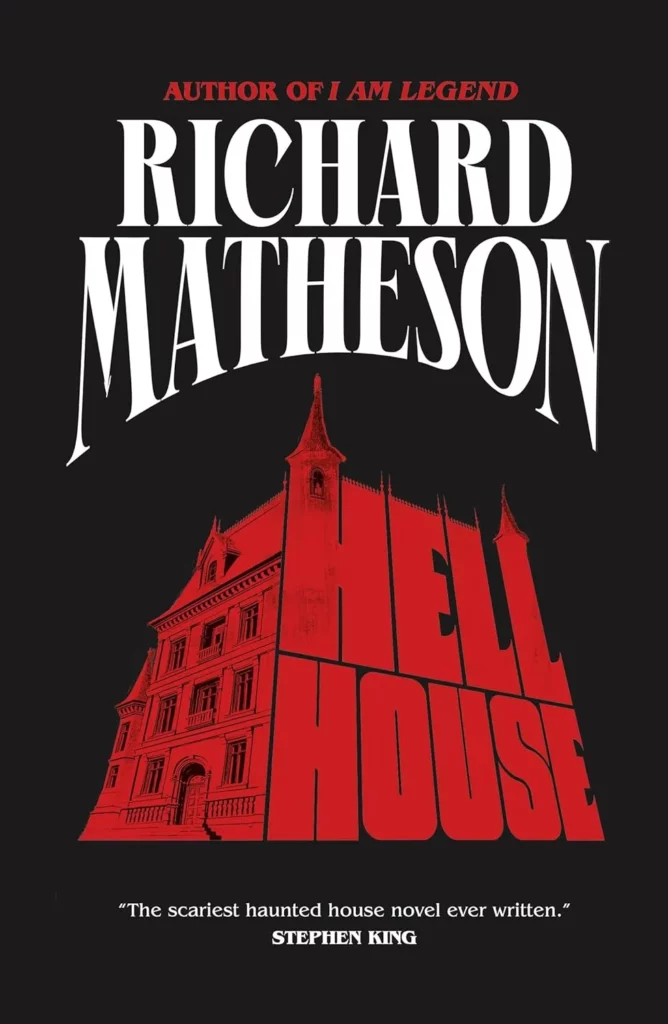
Hell House follows a group of investigators sent to spend a week inside Belasco House, a site considered the most violently haunted in recorded history.
Science, spiritualism, and personal agendas clash in a house that assaults minds and bodies. An experiment rapidly becomes a test of psychological and physical endurance, pushing everyone to their limits.
Publishing year: 1971
Page count: 304
The Reading Experience
I’d say the start was a bit slow for me. I didn’t get sucked in right away, but there was an early sense of discomfort that worked. But that’s what kept me going. At first, the writing felt a bit rigid and old-fashioned, but after a while, I got the hang of it. It matches the mood.
After a few chapters, I found myself reading faster without even realizing it. I wouldn’t say it’s an addictive read, but it definitely kept me hooked. I had that quiet dread feeling more than once, where I wasn’t sure if I wanted to turn the page or close the book and walk away for a minute.
And yes, it played with my head a little too much, and I ended up regretting picking it up late at night.
What Holds the Story Together
The characters make the story work. Dr. Barrett was great. He was arrogant, condescending, and obsessed with his theory. I couldn’t stop watching him try to force logic onto something that clearly wasn’t having it.
Florence really got to me. I kept changing my opinion of her. One minute, I thought she was being real and open; the next, I wasn’t so sure. That back and forth made her one of the most interesting parts of the book.
I liked Fischer the best, though. He doesn’t say much, but you can still feel the weight of his experience in every scene. There’s definitely more going on beneath the surface, and the book knows exactly how much to reveal and how much to hold back.
This house isn’t meant to send anyone running. It creates pressure by holding everything back. Each scene adds weight without letting up, making the story feel thick and heavy. The rooms have a certain energy, the air feels more intense, and the space feels smaller the longer you stay.
Does It Really Work?
Yeah, the internal logic is solid. The events gradually get more intense, and the characters’ reactions, while not always the smartest, feel true to their personalities. Even the more intense scenes make sense in the grand scheme of things, but I’ll admit that a few of them went a bit over the top with the info.
Some scenes went on a bit longer than needed. The impact was already there, but the extra detail just made it less noticeable instead of more intense. It didn’t ruin the reading, but I could have done without it.
The ending was just what it needed to be. Nothing too dramatic, nothing overly drawn out. It took care of the important stuff and then just stopped.
It’s also similar to The Haunting of Hill House in terms of structure. The way the group was set up, the dynamic among the members, and the slow psychological unraveling all feel related. It’s not a carbon copy, but it definitely pays homage to her style.
If you’re looking for something with a similar tone and emotional pacing, I also reviewedThe Staircase in the Woods. That one really dives into some unresolved tension.
Who This Book Is For
- Readers who like psychological horror with minimal nonsense will enjoy this.
- Readers who enjoy watching rational people fall apart.
- Readers who prefer dread over gore.
Who Should Skip It
- If you’re into fast-paced, action-packed stories.
- Readers who need clear lines between good and evil.
- If you’re not into heavy stuff like abuse and sexual violence, you might want to look for something else.
Content Warning
This book has some pretty heavy themes, like abuse and sexual violence. Some readers might want to steer clear of it for that reason.